
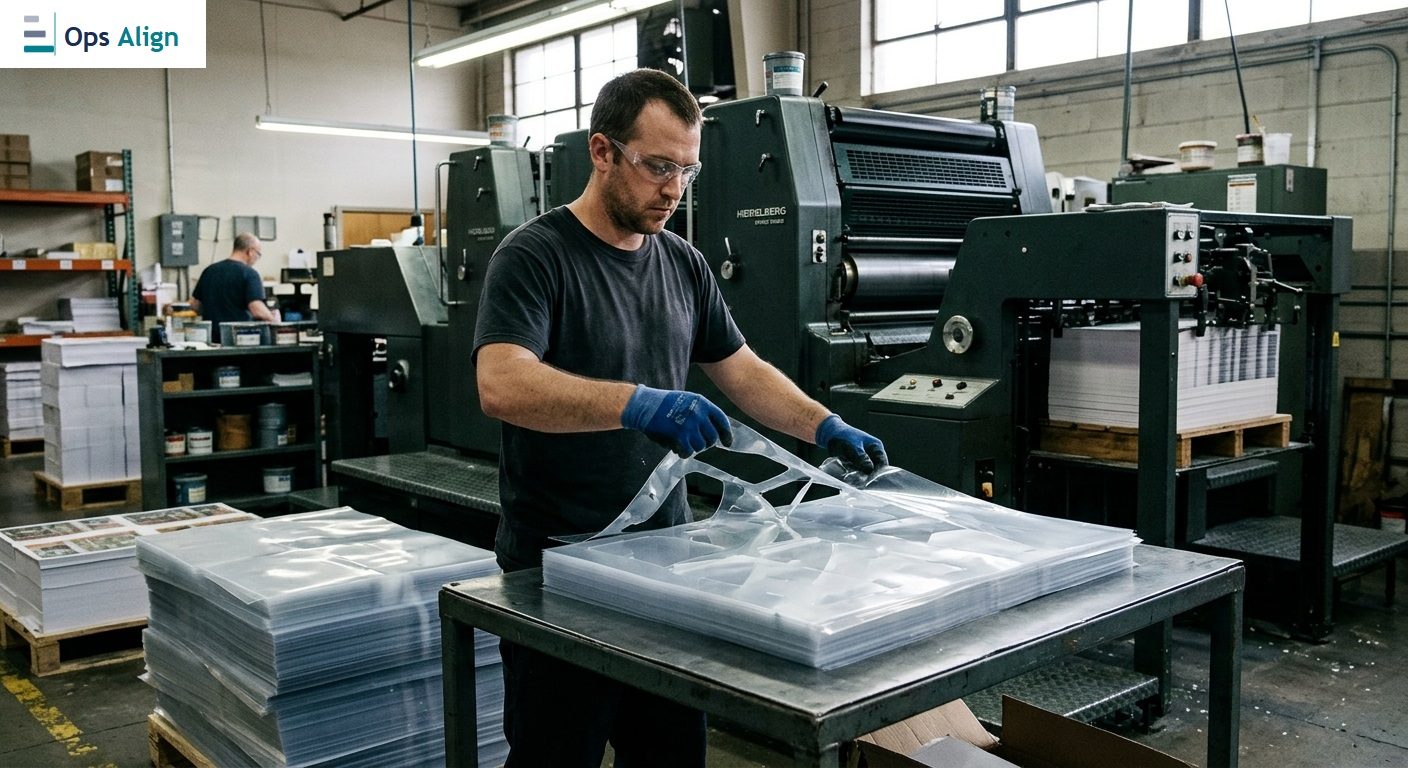
More than a decade ago, I was working in a rigid transparent plastic die-cutting factory in Canada. The business was going through a merger at the time.
Like most manufacturing transitions, there was plenty to deal with. But one particular production problem has stayed with me all these years.
It wasn't a complicated machine or an expensive piece of equipment.
It was a manual operation that looked so simple we hadn't paid enough attention to the skill involved.
The production problem
We manufactured rigid transparent plastic packaging. One of the operations involved die-cutting sheets of plastic into the required shapes.
The cutting process scored the sheets but didn't completely separate the finished pieces from the surrounding material.
The sheets would fall onto a collection tray and stack up. An operator would grab a quantity of sheets, separate the finished die-cut pieces from the waste frames by hand, and repeat the process.
It looked straightforward.
But we had a problem with inconsistent production.
Some operators could process considerably more sheets than others. Same process, same material and equipment, but different output.
We had documented the production numbers by operator, so the variation was clear.
Naturally, we treated it as a continuous improvement problem.
We used a fishbone analysis, involved engineering and started exploring ways to make the process more consistent.
We tried different engineering approaches, including ways to eliminate the manual separation step.
They didn't deliver what we needed. More sophisticated technical solutions were possible, but they were beyond what the business could reasonably afford.
So we went back to the process itself.
The part we hadn't really studied
Looking back, I think we made a fairly common mistake.
Because the manual operation appeared simple, we hadn't examined the actual method closely enough.
We were investigating the output differences, but we hadn't spent enough time asking why certain operators were so much better at the task.
We had a senior operator who had mastered it.
When we began studying how he worked, we realized this wasn't simply a matter of grabbing plastic sheets and pulling the pieces apart.
There was a particular number of sheets he would grab each time. A way of holding them, applying force and separating the die-cut pieces from the surrounding waste.
There was also a rhythm to the work.
Anyone who has spent time in a factory has probably seen this. An experienced operator makes something look effortless. Then someone new tries it and discovers how much skill is involved.
What appeared to be a simple repetitive task was actually a learned technique.
And the knowledge wasn't in our SOPs. It was in the hands and experience of someone who had spent years doing the work.
Making that knowledge available to everyone
We made him our Process Master.
He was happy to teach his method, and we worked with him to turn that experience into something others could learn.
We documented the technique in the SOP, established a quality gate, identified the skills required and created a skills matrix.
We also introduced video job aids at the workstations so operators could see how the task should be performed, rather than relying entirely on written instructions.
The skill was no longer something a new operator simply had to pick up through trial and error.
We had a method for teaching it.
And we could assess who was trained and where further coaching was needed.
There was one other thing I felt strongly about.
His name went into the process documentation as the originator of the method.
Not simply as someone who had participated in an improvement project. The method was attributed to him.
I think that matters.
In manufacturing, the names on our procedures are often those of managers, engineers or quality personnel who prepare and approve the documents.
But the knowledge that makes a process work often comes from the people who have been doing the job for years.
Why shouldn't their contribution become part of the company's documented history?
The human side of the process
As we worked on training and improving consistency, we also saw another issue.
Fatigue.
The operation required a certain amount of arm and body strength. As operators spent more time on the task, fatigue began to show.
We could see it in their movements and in the production numbers.
The method might have been effective, but we couldn't ignore the physical demands of the work.
So we introduced job rotation every two hours and cross-trained operators.
That allowed us to share the work and respond to the fatigue we were observing.
It wasn't a claim that we had eliminated every ergonomic risk. But it was a practical change in how the operation was managed.
What started as a project to reduce output variation had become something broader.
We were identifying skills, transferring knowledge, developing people and paying closer attention to the physical demands of the job.
And much of it was achieved without the expensive equipment we had initially considered.
What does this have to do with a merger?
The factory was going through a merger at the time, and that experience has influenced how I think about operational transitions ever since.
When businesses merge or are acquired, there's naturally a lot of attention on equipment, capacity, systems, costs and financial performance.
There is pressure to standardize processes, establish common expectations and get everyone working toward the same goals.
All necessary.
But I think there's another question that deserves more attention.
What do the experienced people in these factories know that isn't written down anywhere?
Some have spent 10, 20 or even 30 years developing practical knowledge about processes, machines, materials and people.
Others may be newer to the organization, bringing different experiences and fresh ideas.
We need both.
Experience doesn't automatically mean a method is the best one. Sometimes long-established practices need to change.
And newer employees can spot things that experienced people have become accustomed to.
But during an integration, we shouldn't assume that the new way is always better simply because it's new, or that the old way should remain simply because it has always been done that way.
We need to understand the work.
Study the methods. Listen to the people. Test what works. Then establish a standard that everyone can learn and improve.
That is how knowledge becomes an organizational capability rather than something the business depends on one individual to remember.
Are we looking only for what's wrong?
This experience also made me question something about how we practise continuous improvement.
When we introduce Kaizen into a factory, we train people to identify waste, abnormalities, bottlenecks, defects and opportunities to improve.
Over time, our eyes become very good at spotting problems.
I believe strongly in this approach. I've used it throughout my career.
But could that same habit sometimes make us overlook what is already being done well?
In that die-cutting operation, we had spent time trying to understand why the process wasn't performing consistently.
Yet the answer we eventually needed came from studying someone who was performing it exceptionally well.
What if we had started there?
The same question applies beyond production.
Why does one supervisor have a team that communicates openly while another struggles?
Why does a particular operator consistently produce good work?
Why does one production cell handle changeovers smoothly while another is always playing catch-up?
We investigate poor performance. We should be just as curious about good performance.
Not to copy practices blindly, but to understand what makes them successful and whether those lessons can be transferred elsewhere.
A lesson I still carry
Looking back at that die-cutting process, the most valuable part wasn't simply creating another SOP or skills matrix.
It was recognizing that a job we had treated as mundane contained knowledge we hadn't properly understood.
Our senior operator already had that knowledge.
We needed to learn from him, make the method trainable and give him credit for what he had developed.
And when we saw fatigue affecting performance, we needed to consider the people doing the work, not just the production numbers.
For factory owners, particularly those going through growth, succession, acquisition or integration, I think this is worth considering.
How much of your factory's performance depends on skills that exist only in the heads and hands of a few experienced people?
And how much of that knowledge would remain if those people were no longer there tomorrow?
Before we invest in another solution, perhaps we should spend more time understanding what is already working.
Before we replace an old practice, let's understand why it works.
And before we ask people to change, let's recognize what they already know.
We have trained ourselves to study what goes wrong. We should be equally curious about what goes right.
Sometimes the improvement we're looking for is already happening on the factory floor.
We just haven't taken the time to understand it.
Going through growth, succession or integration?
OpsAlign works with owner-led factories on the floor, with supervisors and operators, so the knowledge that makes the plant work becomes a standard everyone can learn.
Explore servicesCommon questions
Why does output vary so much between operators on the same manual job?
Simple looking manual jobs often depend on a learned technique: how much material to handle, how to hold it, how to apply force and the rhythm of the work. If that method is not studied and written into the standard, each operator works it out alone and output varies.
How do you capture an experienced operator's knowledge?
Study how the best operator actually does the job, document the method in the SOP, add a quality gate, build a skills matrix and use video job aids at the workstation. Credit the operator as the originator of the method.
What knowledge is most at risk during a manufacturing merger?
The practical knowledge that lives in experienced people's heads and hands and was never written down. Before standardizing processes after a merger, study the methods, listen to the people, test what works, then set a standard everyone can learn.
Case details are Nash Krishnan's firsthand account. A shorter version of this story appeared on LinkedIn.

About the author: Nash Krishnan is the founder of OpsAlign. He works with owner-led manufacturers to strengthen daily operating systems, develop frontline leadership and build continuous improvement cultures that last.