01
Daily Huddle Structure
A standing cadence — who meets, when, about what — that runs whether or not the owner is in the building.

OpsAlign helps owners turn the experience and judgment already inside the business into a living operating system: one that learns, takes ownership, and grows stronger through change.
Not every plant starts in the same place. Drag the signal — watch the noise settle into a rhythm.
Nash is on the floor every shift. Trust comes before recommendations — the first proof is a small commitment, made and kept. In parallel, the real decision paths and where knowledge is concentrated get mapped, not assumed.
For a plant that was functioning but owner-dependent, this is close to the finish line. For one that was genuinely struggling, this is where the daily cadence, decision rights, and supervisor structure actually go in and start holding under real pressure.
For a deeper rebuild, this is where capability is fully transferred — not just installed, but tested through a real stretch of pressure without the owner stepping back in. The plant can show a buyer, successor, or a tired owner that it doesn't depend on one person.
ROOT is the short, practical expression of the deeper method. It's how an owner sees the work begin without learning a consulting model first.
Trust and permission come before recommendations. Real change starts with respect for the people, the work, and the owner who built the business.
Find where work, decisions, and knowledge actually live — across every shift, not just the office.
Align routines, decisions, and ownership around the work that actually moves the business.
Move capability into the team and prepare the operation's next chapter — with or without you in the room.
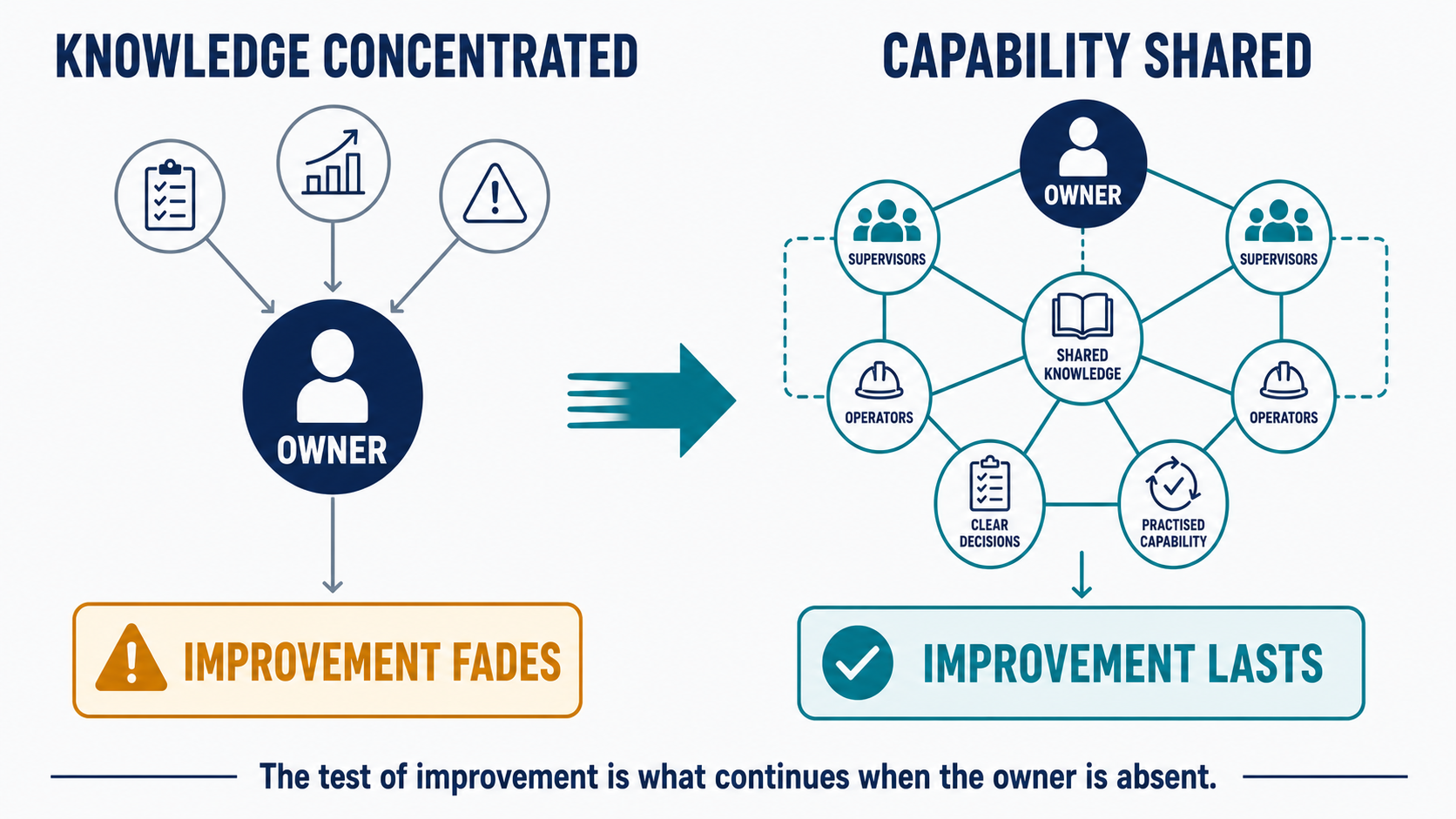
Same people, same equipment. Pull the handle and watch judgment, knowledge, and ownership move from one person to the whole team.
Every judgment call still comes back to the owner, even the small ones.
Concentrated in a few heads — the ones who've been there longest.
Surface late, get fire-fought, and quietly return next week.
Depends on who remembers to chase it.
The owner is the ceiling. The plant can't outgrow their attention.
Made at the point of the problem, by the person closest to it.
Documented, taught, and practiced across the team.
Visible on the floor before they cost a shift.
Built into the daily cadence — nobody has to chase it.
Can scale, sell, or transition without the owner in every room.
Not more philosophy — the parts list. What's physically and operationally in place when the engagement ends.
A standing cadence — who meets, when, about what — that runs whether or not the owner is in the building.
A written answer to "who can approve this without calling the owner," for the calls that come up every week.
What gets handled on the floor versus what genuinely needs to go upstairs — and how fast.
Where knowledge still lives in one head, and the plan to get it into at least two.
Named ownership of each shift and area — not just a title, a working chain of accountability.
The boards and daily numbers that make a problem visible before it costs a shift, not after.
The phases aren't a rigid sequence. They give the work enough structure to respect the people and realities of each factory.
Start with what has survived, what matters, and the permission to challenge it constructively.
Listen across the operation to understand the visible process and the hidden operating system.
Build relational currency through honest conversations, practical wins, and visible follow-through.
Bring priorities, measures, systems, and leadership behaviour into the same daily rhythm.
Move authority with capability so supervisors and teams can act responsibly.
Embed the habit of seeing problems, learning, and improving the standard.
Make the business more visible, transferable, and ready to carry its strength forward.
The conversation starts with the operating reality in front of you. The practice gives us a way to build from there.
Book a 20-minute conversation